Mostrando entradas con la etiqueta canada. Mostrar todas las entradas

10/13/2010

Chiste del Dia - Inversiones en Cuba


EFE - Cuba dice que EE.UU. habría invertido 2.000 millones de no existir el bloqueo

Nota: De no haber nacionalizado todas las empresas de EEUU en 1960, Cuba seria hoy uno de los países mas prósperos de América Latina, algo superior al condado Miami Dade, donde solo habitan el 20% de los cubanos y tiene un PIB superior a todos los países del ALBA juntos, incluyendo Venezuela que es exportador de petroleo.

Si los estadounidenses hubieran invertido esa cifra en Cuba, ahora mismo estarían con sus activos congelados y la repatriación de capital paralizada como lo están los españoles y canadienses, la deuda de Cuba seria muchísimo mayor y sin esperanza de pagarse como la de muchos otros, mas de 300 empresas, que se han visto obligadas a declarar sus inversiones como perdidas y salirse de un país sin garantías jurídicas y donde acusándote de cualquier cosa te confiscan tus propiedades y se niegan a pagarte lo adeudado, como le esta pasando al empresario chileno Max Marambio, a quien se le adeuda mas de 300 millones y ahora lo acusan de corrupcion para no pagar.

Un país gobernado por unos malabaristas que solo buscan mantenerse en el poder, cambiado el juego según su conveniencia, no es confiable para invenciones ni de alto riesgo, solo algunos tontos, principalmente por afinidades ideológicas o lavadores de dinero sucio se han dejado arrastrar por ofertas tentadoras de los Castro, quienes ofrecen mano de obra esclava, hasta que chocan con la realidad y salen con el rabo entre las patas.

Estos empresarios oportunistas que van a esclavizar al trabajador cubano, un día tendrán que responder ante la justicia, firma aquí contra la esclavitud laboral en Cuba

10/09/2010

LASA 2010: La academia pro-castrista en Toronto (Comentario)


Lázaro, te dejo mi comentario por acá, me motivo ver lo tragicómico de tu post y me extendí tanto que no paso, igual es bueno compartirlo con los lectores de Pinceladas de Cuba y dejare ademas del comentario, el link a LASA 2010: La academia pro-castrista en Toronto


Increíble, es tal es desespero por recibir los dolares del imperialismo que ya no saben que inventar, según estos mismos comunistas, antes los yanquis solo iban a Cuba a buscar prostitutas y a orinarse en el busto de Marti, hoy piden a gritos que visiten la isla y vayan a invertir sus dolares en las misma fabricas que les nacionalizaron hace cincuenta años, antes decían que el socialismo iba a desplazar al capitalismo y hoy por hoy insisten en mantener sus políticas económicas centralizadas y cada día mas en manos de militares, mientra lloran por asistencia financiera del enemigo ideológico para programas nacionales que son responsabilidad exclusiva del estado y mas aun cuando este se dice llamar socialista, humanitario y progresista, que es eso de estar mendigando dinero de los imperialistas,la CIA y la Mafia de Miami.

Un día te dicen que el embargo no ha funcionado, que es obsoleto y que ha fracasado, que no ha alcanzado sus objetivos de debilitar a la revolución ni quebrantar la voluntad y el espiritu de resistencia del pueblo cubano, al otro día te dicen que el embargo ha causado tantos millones en perdidas por tal concepto mas otro tanto por otro, que ha causado tantos miles muertos, que no les permite ni respirar y esa es la verdad, ya no hay dinero del imperio soviético y el de Chavez se va por el tubo de la corrupción, es ahora cuando se están tragando el orgullo financiado por potencias extrajeras, solo les queda la trata de blancas y negras, la renta de esclavos profesionales, el narcotrafico esta en la mirilla y la estafa a grupos terroristas esta en picada, así que mas lagrimas de cocodrilo veremos en el futuro, a no ser que los socialistas en el poder del imperio le allanen el camino de la continuidad, dándole créditos y dolares de turismo y eso no lo veo muy probable de momento, tal vez si siguen llorando con esta fuerza para el próximo gobierno demócrata en el 2020 vean la luz,jajajajajaja.

Saludos

3/07/2010

The Globe and Mail: Editorials, Cuba's other face


TheGlobeAndMail - Canadians vacationing in Cuba may be too busy sipping mojitos and frolicking in the ocean to consider last week's tragic death of a Cuban political prisoner. But it is a powerful reminder of the island's repressive underbelly, and illustrates the Cuban government's continued and blatant disregard for human rights and civil liberties.

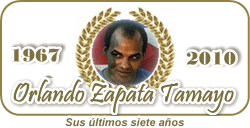
Orlando Zapata Tamayo, a 42-year-old carpenter and plumber, stopped eating Dec. 3 to protest the conditions of his detention, and died in a hospital in Havana last Tuesday. He is the first political prisoner to starve himself to death since 1972, when Pedro Luis Boitel, a student leader and poet, suffered the same fatal end.

Mr. Zapata was detained in a 2003 crackdown known as "Black Spring", alongside 75 other opposition activists, who advocate peaceful political change but are seen by the Cuban government as U.S. mercenaries. He was initially jailed for three years for "disrespecting authority"; however, this sentence was increased to 25 years in subsequent trials, after he was charged with disobedience and disorder in a penal establishment.

Amnesty International called Mr. Zapata's death a "terrible illustration of the despair facing prisoners of conscience who see no hope of being freed from their unfair and prolonged incarceration." The human rights group called for the immediate release of all prisoners of conscience, and said a full investigation must be carried out to establish whether ill treatment played a role in the case of Mr. Zapata.

Hillary Clinton, the U.S. Secretary of State, and officials from the European Union also condemned Mr. Zapata's death, with Spanish Prime Minister Jose Luis Rodriguez Zapatero calling for the release of all political prisoners. Reina Luisa Tamayo accused the Cuban government of murdering her son.

Raul Castro, the Cuban president, took the unusual step of expressing public regret for Mr. Zapata's death. But he used the occasion not to announce a political opening, but to deny that the deceased was mistreated and to attack the U.S. The only torture taking place on the island, Mr. Castro said, is at the U.S. military base at Guantanamo Bay, where terror suspects are held.

It is clear that he does not intend to heed the international demand to free all dissidents, or to permit peaceful opposition voices in this country of 11 million.

In fact, Mr. Zapata's death provoked another act of repression, with dozens of his supporters locked up last week to prevent them from attending his funeral in Banes, his home town in the east.

Cuba's opposition believes, however, that the tragedy will galvanize resistance against the government. "I think there is going to be a 'before' and an 'after' in the murder of Tamayo," said Marta Beatriz Roque, a Havana dissident also jailed in 2003 and later released for health reasons.

Historically, the Cuban dissident movement has been weak and fraught with internal conflict. Government control of all media - and the limited access Cubans have to the Internet -has made it difficult for opposition groups to mobilize.

But the movement may find strength and unity from Mr. Zapata's decision to starve himself to death. On Friday, five dissidents, four behind bars, announced they had begun hunger strikes aimed at forcing the government to free all political prisoners. Mr. Zapata was a poor, black man from the countryside - the very sector of society the Cuban Revolution was supposed to help.

As Canadians book their all-inclusive Veradero getaways this March break they would do well to remember that for many, Cuba is no island paradise.

10/19/2009

CARTA DDE LOS REPRESENTANTES EN EL EXTERIOR DEL PARTIDO SOCIALDEMÓCRATA DE CUBA A LA OPINIÓN PÚBLICA INTERNACIONAL.

Ante la desidia, el desinterés y el silencio de la Organización de Naciones Unidas, la Organización de Estados Americanos, la Unión Europea y sus respectivas Comisiones de Derechos Humanos, nosotros, los representantes del Partido Socialdemócrata de Cuba en el exterior, hacemos un llamado urgente a Amnistía Internacional, la Cruz Roja Internacional, Human Rights Watch y otras organizaciones internacionales, así como a los Gobiernos de Suecia, Polonia, República Checa, Estados unidos y Canadá, a expresar su protesta, desaprobación y rechazo al cerco policíaco-militar de la dictadura cubana, contra la casa de Vladimiro Roca, donde se encuentran además, Beatriz Roque Cabello y un grupo de Comunicadores Comunitarios, cuyo único objetivo había sido reunirse pacíficamente para profundizar y desarrollar sus habilidades para ampliar sus informaciones sobre la realidad de Cuba y los crímenes y abusos de la represión y el terror de la dictadura fascista de nuestro país.

Once opositores cubanos se encuentran sitiados, cercados en un pequeño campo de concentración al estilo nazi, por las fuerzas de la Gestapo castrista, que no dejan entrar alimentos ni otros grupos disidentes que quieren expresar su solidaridad.

No se trataba de una reunión para asaltar un cuartel, una estación de policía u otra dependencia gubernamental. Era simplemente una reunión de opositores pacíficos para precisar sus tareas en la difusión de los abusos del gobierno cubano y, la terrible situación de hambre, miseria y falta de libertades en nuestra querida isla.

Mientras la OEA y la ONU expresan su rechazo a las instituciones constitucionales de Honduras y, toman medidas de extremas sanciones contra el gobierno legítimamente constituido en ese pequeño país, miran para otro lado ante los crímenes y abusos de la más vieja dictadura de América Latina.

No han sido capaces de llamar a la dictadura cubana, al respeto de los Pactos de la ONU, que hace poco firmaron y no han hecho otra cosa que burlarse de esos pactos y arreciar la represión y el terror, solo comparable a los años iniciales, de los fusilamientos y las largas condenas de cárceles, contra todos aquellos que se opusieran a la destrucción de las democracia y sus instituciones.

Llamamos también al exilio cubano y a toda la Oposición interna, a cerrar filas en la defensa de Vladimiro Roca, Beatriz Roque y los comunicadores comunitarios, para no permitir una vez más, la impunidad abusiva de los que han destrozado nuestro país. Este es un momento de unidad y lucha en defensa de los derechos que tienen los cubanos, a otra visión y otros programas para devolverle a la nación cubana la reivindicación de la democracia y el conjunto de derechos y libertades a las cuales nuestro pueblo tiene derecho.

La oposición pacífica cubana lucha por la devolución del bienestar a la población; por la libertad de entrar y salir del país cuando lo estime conveniente; de entrar a los sitios y hoteles donde hoy sólo entran extranjeros; de elegir a sus representantes en elecciones libres, bajo supervisión internacional; por la libertad de expresión, la libre información, el derecho a Internet y a las publicaciones y televisión de otros países; por la libertad a la propiedad privada y la libre empresa en la agricultura, el comercio, la industria y otros sectores económicos; por una educación sin ideología; por una excelente salud pública para todos y no para los extranjeros y la Nomenklatura; por una nueva Constitución ajena a la ideología comunista, que respete todas las libertades a las cuales tenemos derechos.

Exigimos con toda nuestra fuerza, el levantamiento del cerco a la casa de Vladimiro Roca; el respeto a la vida e integridad de todas las personas sitiadas con absoluta impunidad, por las fuerzas de la dictadura militar cubana, a quienes hacemos responsables de cualquier cosa que le pase a esos luchadores pacíficos.

¡Libertad para Vladimiro Roca, Martha Beatriz Roque y los Comunicadores comunitarios!

¡Por la democracia, la libertad y los derechos humanos de todos los cubanos!

¡Abajo la Dictadura fascista y totalitaria de Cuba!


Asdrúbal Caner Camejo
Representante en Canada
Partido Socialdemócrata de Cuba
(PSC)

Luis Tornes Aguililla
Representante en Francia
Partido Socialdemócrata de Cuba (PSC


Nelson Núñez Dorta
Representante en México
Partido Socialdemócrata de Cuba
(PSC)

8/18/2009

Encarcelado en Camagüey ciudadano Canadiense.


Por: Jorge Alberto Liriano Linares, Prisionero Político, desde la prisión dicta los textos.


Prisión Cerámica Roja, Camagüey/14 de Agosto/ del Buro de trabajo Hablemos Press/ Acusado de un supuesto e improbable delito de corrupción de menores, arribó el 14 de agosto, a la prisión Cerámica Roja, el ciudadano extranjero de origen canadiense Sergio Booclers, de 59 años de edad, natural de la ciudad de Quebec, el cual ha visitado la isla tradicionalmente durante los últimos 15 años en calidad de turista.

El Sr. Booclers detenido por los órganos de la Seguridad del Estado cubanos el pasado 5 de agosto alega sentirse secuestrado y que se han desestimados todos los derechos individuales y legales que le asisten como ser humano y ciudadano extranjero.

Cuando el pasado 14 de julio funcionarios de emigración y extranjería le incautaron su pasaporte prohibiéndole la salida de la municipalidad de Camagüey para posteriormente ser detenido por las fuerzas represivas de la inteligencia cubana donde le fue confiscada una cámara fotográfica y su memoria de datos.

Luego de pasar 7 días en condiciones infrahumanas en los calabozos de la tercera unidad de la policía donde fue maltratado y torturado brutalmente en los interrogatorios es enviado a la cárcel provisional donde permanece aislado e incomunicado, sin agua potable, con escasa ventilación, con pésima alimentación y a merced de la hostil represión de los militares.

Sergio Booclers es un canadiense que dice ser amigo del pueblo cubano. Durante 15 años a visitado la isla extendiendo en largo peregrinaje su solidaridad con la pobreza del pueblo.

En el barrio insalubre del Porvenir de esta ciudad de Camagüey el Sr. Booclers es reconocido por sus moradores como el enviado de Dios por sus incontables e incalculables obras de caridad que incluye entrega de juguete a los niños, ropas, zapatos y alimentos a las familias mas necesitadas, medicamentos para los enfermos y hasta materiales de construcción para las familias que quedaron sin techos al paso del ciclón Ike el pasado año que el gobierno cubano dejó abandonadas y olvidadas a su suerte.

También el enviado de Dios en el barrio Porvenir mencionó la construcción de un templo para orar a Dios, oficiado por la Iglesia Evangélica Pentecostal y a mediado con organizaciones de solidaridad humanitaria de su país para la instalación de obras sociales que permitan mejorar el nivel de vida del pueblo cubano.

Jamás imaginó este solidario y misericordioso canadiense que sus obras humanitarias en favor de los pobres en un barrio marginal de los muchísimos que abundan en Cuba lo conllevaría a conocer la naturaleza represiva del régimen y sus fragantes violaciones de los derechos humanos. Se pone de manifiesto una vez más la manipulación, la injusticia superlativa y la doble moral del gobierno cubano.

Es que como dice y razona el propio señor Sergio, durante 15 años de visita a la isla sintió en carne propia el dolor y el sufrimiento de este pueblo, conoció el verdadero rostro de la Cuba socialista, sus miserias, desigualdades y discriminaciones conoció a un pueblo hundido en la pobreza y el terror sin derechos ni libertades democráticas oprimidos, sometidos, explotados y como paradoja también usados y manipulados por el régimen y sus gobernantes.

Booclers conoce la realidad Cubana es por lo que se han ensañado ruin y cobardemente con el un nuevo golpe a la dignidad humana contra un hombre libre. Crímenes como este hacen temblar la injusticia.

7/16/2009

Cuban ‘rafters’ Commemorate Tugboat Massacre

(L-R) Nelson Taylor, Miguel Figuerola and his son Dennis and wife Susana Gonzalez, Lazaro Gonzalez (no relation), Juan Carlos, and Asdrubal Caner pose with a makeshift raft. (Pam McLennan/The Epoch Times)

By Pam McLennan
Epoch Times Staff

OTTAWA—On the early morning of July 13, 1994, 72 Cubans, among them nine children and a five-month-old baby, set out in an old but sturdy tugboat from the Port of Havana, heading for the United States and a new life of freedom.

The small wooden vessel was about seven miles out to sea when it was ambushed by four state-owned boats. The larger metal-hulled boats encircled the tug. Two of the boats stopped the tug and repeatedly rammed its hull until it split and began taking on water.

In the meantime the other two boats, which were equipped with firefighting hoses, were spraying the people on deck, driving many overboard and others to flee to the cargo hold.

Witnesses claim that the four boats then repeatedly drove around the sinking vessel at high speed to create a whirlpool that sucked those floundering in the sea under the water and to cause the tug to sink even faster, while continuing to spray both the people and the boat with high-powered jets of water.

No attempts were made to help the people on board the tug or to rescue those who were in the water despite the presence of a government Coast Guard cutter. Only when a Greek liner happened upon the scene did the Coast Guard start to pull people from the sea.

The old tug, named 13 de Marzo (13 March), sank. Of the 41 who perished, no bodies were returned to their families as the Cuban government refused to recover the victims’ bodies.

What was dubbed the Tugboat Massacre has been recounted by the survivors and investigated by numerous agencies including Amnesty International and the UN Rapporteur on Cuba.

The Cuban government claimed that the tugboat sank because of an accident that occurred as the state-owned boats tried to stop a fleeing stolen vessel, and that there was no deliberate attempt to sink the tug.

The Inter-American Commission on Human Rights, however, saw it differently.

“The Cuban State is responsible for violating the right to life of the 41 people who were shipwrecked and perished as a result of the sinking of the tug 13 de Marzo … for violating the personal integrity of the 31 persons who survived the sinking of the tug … as a consequence of the emotional trauma it caused,” stated a report by the commission.

“The Cuban State is responsible for violating the right to freedom of movement and the right to a fair trial of the 72 people who attempted to flee Cuba…”

Rafters


To commemorate the 15th anniversary of the Tugboat Massacre, Juan Carlos, a resident of Guelph, Ontario, brought a makeshift raft to Parliament Hill on Monday similar to the one he had used on the open sea to escape from Cuba in 1994.

Carlos is a “rafter,” one of thousands who fled Cuba in 1994 after Fidel Castro declared that people were free to leave the country without reprisal. He used a combination of innertubes and wood to cobble a raft that would take him to the United States and escape what he saw as Castro’s oppressive regime.

Carlos said that at 17 he was badly beaten for using a public washroom that was designated for use by tourists only.

“From that day on I have been very angry. I wonder how Canadians would feel if they were beaten for using a public washroom in their own country but which foreign people are allowed to use. I won't welcome tourism in my country until the Castro government is over. I would like to tell the Canadian people that the only thing you are doing by going to resorts in Cuba is hurting the Cuban people.”

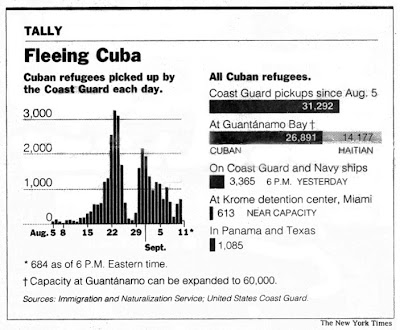
After his escape, Carlos languished in Guantanamo Bay along with 32,000 other expatriate Cubans, awaiting their fate while Castro and then-president Bill Clinton took nearly a year to negotiate a revision to the Cuban Adjustment Act, the outcome of which was the “dry foot wet foot” policy of May 2, 1995.

This policy states that Cubans who flee to the U.S. will be accepted if they make it to dry land. If they are stopped while on the waters between the U.S. and Cuba they will be sent back.

Eventually Carlos was sent to Spain. He subsequently lived in the U.S. and then Canada, where he married a Canadian woman.

‘Canada has huge leverage’


Asdrúbal Caner, a representative of the Social Democratic Party of Cuba, is also a rafter. It took Caner four days during stormy weather to cross from Santiago to Guantanamo Bay in August 1994. Without food or water for most of the trip, he weighed just 45 kg (100 pounds) when the U.S. rescued him.

Caner says that while about 800,000 Canadian tourists visit Cuba each year, tourism doesn’t benefit the people of Cuba much. The money mainly goes to the Cuban government to support the armed regime and keep the people oppressed.

One family of expat Cubans attending the event was from Switzerland. Miguel Figuerola, his wife Susana Gonzalez, and their son Dennis Figuerola left Cuba when Miguel got a job with the U.N.

They said the Canadian government is in some ways complicit in the difficult life that Cubans live, as Canada is Cuba’s second highest trading partner and has invested in Cuban businesses including Sherrit International (nickel and oil).

Despite the fact that Canadian businesses create jobs for Cubans, Figuerola says that the people aren’t paid directly by the companies. The monies are collected and distributed by the Castro government, which are used to support the army.

Toronto resident Lazaro Gonzalez’s father was a rafter as well. His father was sentenced to 28 years in jail in the 1960s for speaking publicly against the communist regime. After 18 years in prison Castro freed all prisoners and allowed them to leave the country. His father boarded a raft and was never heard from again.

Gonzalez said he was fired from his job as a professor of economics at Havana University when it was discovered that his father had been a political dissident.

Nelson Taylor Sol, the Ottawa representative of the Cuban Canadian Foundation, said that Canada is the biggest investor in Cuba and he would like to hear the Canadian government publicly denounce the Castro regime as murderers and thugs, and to have a similar policy of sanctions against the Cuban government much like the U.S. has.

“We think that Canada is a very important country to change what is happening in Cuba, as Canada has huge leverage that they could apply to Cuba. People ask why is Canada not doing anything,” he said.

“We would like Canada to publicly state support for the Cuban dissidents. Some are in jail as prisoners of conscience, recognized by AI, and we would like Canada to officially and publicly recognize the Cuban Opposition movement in the same way that Burmese democracy leader Aung San Suu Kyi is supported. That would really encourage the Cuban people.”

As for Carlos, he said he plans to keep returning to the Hill each year on the anniversary of the Tugboat Massacre.

“My plan is to do this every year at this time until the Canadian government allows us to testify in front of the Canadian parliament and say what we have witnessed as survivors of the genocide the Cuban government has been committing for the past 50 years.”

7/14/2009

PROTESTA DE BALSEROS EN OTTAWA


Ayer lunes, tal y como estaba previsto Juan Carlos Suárez, un balsero cubano radicado en Guelph, Ontario, miembro del Partido Socialdemócrata de Cuba, realizó una manifestación, para llamar la atención del gobierno canadiense, acerca de las violaciones, abusos y crímenes del castrismo contra el pueblo cubano, y la indiferencia y silencio de Canadá, que continúa sus inversiones en la isla y, todos los años envía a más de 800,000 turistas, dinero que va a parar a las arcas del gobierno comunista y no beneficia en nada al pueblo cubano.

En la protesta, Juan Carlos presentó una balsa improvisada, para concientizar a los canadienses sobre los más de 70,000 jóvenes balseros desaparecidos en el mar, en busca de la libertad y el desarrollo personal y familiar. Esos jóvenes se dirigían a los Estados Unidos, a las playas de la Florida, para alcanzar su sueño. La mayoría se ahogó en el mar o fueron comidos por los tiburones. Pero otros, fueron acribillados a balazos por las tropas guarda fronteras del MINIT, y desaparecieron sus cuerpos, sin que la familia jamás supiera de ellos.

Sobre esa tragedia quiso protestar Juan Carlos. Diariamente algún grupo de jóvenes se tira al mar. Son más de 3,000 anuales los que tratan de llegar a territorio de EE.UU. Pero también son miles los que salen a través de traficantes de personas, pagando 10,000 o 15,000 dólares y se dirigen a México o los Estados Unidos. Muchos mueren en el intento.

Y es que, la represión, la miseria, los abusos y la falta de esperanza ante la permanente situación de Cuba, lleva al pueblo a buscar una salida, huyendo del comunismo. Frustración y desespero son parte cotidiana de la vida de la juventud en nuestro país. Y desgraciadamente, el único medio de salir de todo eso, es huyendo a los EE.UU.

Hombres y mujeres, jóvenes y viejos, matrimonios con sus niños, familias enteras huyen del “paraíso comunista” y miles solo encuentran una muerte atroz en las fauces de los tiburones.

El fracaso del comunismo en Cuba se expresa en el gigantesco mercado negro, con recursos robados al Gran Patrón; en la miseria y pobreza generalizadas; en la falta total de deseos de trabajar de todos los trabajadores; en la ruina de la agricultura, la industria azucarera y otros sectores económicos; en la apatía política de la población; en la prostitución de las muchachas y muchachos; en la militarización, represión y abusos sistemáticos contra la población y, en la huida de millones de personas hacia Estados Unidos, España, Canadá y decenas de otros países del mundo.

Mientras Cuba es el paraíso turístico de millones de canadienses, italianos, españoles, alemanes, ingleses, argentinos, mexicanos y de otras nacionalidades, el pueblo cubano y su juventud, tratan desesperadamente de huir del descalabro real de cada día.

Contra todo eso, fue la protesta de Juan Carlos, que se repetirá cada año, hasta que las autoridades canadienses escuchen lo que él tiene que decir. Y yo espero que lo logre, en lo cual tendrá todo mi apoyo, y el apoyo de decenas de cubanos dignos del exilio.

Un abrazo.

Asdrúbal Caner Camejo

Representante del PSC

en Canadá.

Nota: para ver los rostros de parte de las decenas de miles de balseros desaparecidos, pueden entrar a este sitio y a otros sitios cubanos en Internet: http://docs.google.com/Doc?id=dcr6m4r8_0dw72pb

Es posible que tu navegador no permita visualizar esta imagen.

7/12/2009

PROTESTA: !1994 CRÍMENES CONTRA LOS BALSEROS!


PROTESTA: !1994 CRÍMENES CONTRA LOS BALSEROS!

Hi Jen;

My name is Juan Carlos Suarez Rodriguez and Iam the person who will be protesting in front of Parliament Hill this Monday July 13th 2009.

Iam a survivor of the tragedy that already cost over 75,000 lives to the people of cuba in over 50 years of Cuban dictatorship. I left my country in august of 1994 in a raft made of inner tubes and wood ..I spent a year in Guantanamo bay as a cuban refugee awaiting to be allowed to enter the US and finally now Iam here in Canada, a coutry I wanted always to visit.

I was only 17 years old when I was brutally beaten by cuban police in downtown havana just for using a public washroom where only tourists could go...they were Germans and Canadian tourists the ones visiting havana in those days ..Iam 43 years old now but still have the scars in my head and witness in Havana wheeling to testify to the truth of what happened that day.

Iam sending you as much information as I can about what happened on July 13th 1994 and why I will be paying tribute to my fellow cubans who have die trying to escape the "PARADISE ISLAND" Tourism agencies sell unscrupulously to Canadians who are totally missinformed about the reality of our people.

Iam also sending you photos with very disturbing images about this reality and my question is '''''why does the canadian press does not address this reality to canadian people""" """why Canadian press does not exercise their right to investigate violations of human rights in our country as it does in other countries''' and again''''Why do the canadian government continue to turn a blind eye on these violations after being a cosignatary of 6 international treaties against human rights violations'''' it is just Hipocritical and totally offencive to cubans the fact that we are not allowed to visit hotels in our country while Canadians are being served in luxury resorts from where our own people are banned.""""how will Canadians feel if something like that was done to them''''' all this questions are the questions we all cubans have to ask you becuase our embassy here does not represent us but represent the tourism industry that keep them in power.

I will be Building a raft in front of the parliament hill this July 13th to honor the lives of those who are still in the bottom of the sea and ask the Canadian government to respect the international treaties it has signed by looking into crimes against humanity commited by Cuban government.

Attached is also a photo of Raul Castro blindfolding a young farmer acused of treason in the mountains of Cuba at the beguining of the revolution...this young man was later executed by Raul Castro himself ..the message that this government is sending to the world is that it is OK to execute people today and 50 years later became a president of a country without a single question???..

I am planning on building rafts in Ottawa till this government allow me to testify as a survivor and as a witness of the crimes against humanity the government of cuba have commited and for which Iam asking to open an international investigation immediatly...this is 2009 and no government who sign international treaties agains violations of human rights should be doing business with a government suspected of mass murder and genocide...I have the evidences and I have the witnesses and survivors...I just need the media.


On July 13, 1994, at around three in the morning under the cover of darkness, around
seventy 2 men, women, and children boarded the recently renovated tugboat "13 de Marzo.3" They planned to escape the island by making the ninety-mile journey across the Straits of Florida, hoping to reach freedom in the United States. Many also sought the means to send help back to the family they were leaving behind. Eduardo Suárez Esquivel (Eddy), a computer engineer who had attempted unsuccessfully to flee on several occasions, came up with the idea.

Obsessed with the idea of finding a way out of Cuba, he convinced his brother in law, Fidencio Ramel Prieto, to take the tugboat and serve as skipper. Ramel, who was in charge of operations at the Port of Havana, served as one of its Communist Party secretaries and had twenty-five years of commendable service at the port.

This gave him access to the tugboat, which belonged to the state enterprise Empresa de Servicios Marítimos. With all vessels in Cuba under government ownership and tightly controlled to prevent escapes, this access was no small feat.

Raúl Muñoz, a friend and fellow port worker who had been harbor pilot of the "13 de Marzo" and was now the pilot for another tugboat, was recruited to pilot the tugboat for the escape. Several more men joined in to develop the plot.

The plan included numerous family members and close friends. Only Ramel had the entire list of the approximately fifty two passengers who were to go on the journey.

The organizers were divided into groups and each had a leader. Each leader was in charge of getting his respective group to the pier on the designated day.

To keep maximum secrecy, the children were told they were going on an excursion. On three previous occasions, a date had been chosen, but the escape had been aborted when insiders working at the port announced unexpected security measures deemed unfavorable.

Unbeknownst to them, government authorities had been receiving information of the plan, in all probability by infiltrators. The spies are suspected to have been part of the actual planning group -in fact two did not show up for the departure. But, the information may have leaked out to spies through relatives who knew of the plot.

On the designated date, the group quietly boarded the tugboat in the middle of the night and the motors were started. Unexpectedly, people who were not on the list showed up, a few others who were to come did not. It was 3:15 A.M. when they began to make their way out of Havana‟s harbor. Immediately, a tugboat belonging to the same state enterprise initiated a chase.

The pursuing vessel first tried to drive the "13 de Marzo" into a dock. When that proved unsuccessful, it rammed it, attempting to push it towards the reefs by the mouth of the harbor near the Morro Castle.

4 As its crew maneuvered skillfully, the "13 de Marzo" avoided the attacks and kept sailing forward. Free Society Project, Inc. March 2007. ©All rights reserved. Reproduction and redistribution of this material is authorized as long as its source, Cuba Archive/Free Society Project, is cited. 2

People at nearby piers and at the Malecón, Havana‟s seawall, witnessed the attack and were yelling to let them go. Just as the "13 de Marzo" cleared the harbor, two other tugboats that had been waiting for them in the dark, joined the chase. With their water cannons, they started spraying high pressure jets at the escaping vessel.

The wooden "13 de Marzo" was now being hounded by three modern, larger, and heavier tugboats made of steel –the "Polargo 2," "Polargo 3," and "Polargo 5." They were respectively commandeered by Jesús Martínez Machín, a man named David, and one called Arístides.

As the "13 de Marzo" sailed ahead, the pursuing tugboats kept spraying the high-pressure water and getting in its way to make it stop. After around forty-five minutes, when the "13 de Marzo" had reached approximately seven miles out to sea, the pursuing tugboats began ramming it.

Although the "13 de Marzo" had stopped and signaled its willingness to surrender and turn back, the relentless attack continued. The pilot of the "13 de Marzo" attempted to radio an SOS, but the pounding water had damaged the electrical equipment.

A vessel belonging to the Cuban Coast Guard had arrived on the scene, a Soviet-built cutter referred to as "Griffin."

5 But, it stayed back, simply observing the spectacle.

The adults brought out the children on deck to see if this would deter the incessant jet streams and collisions. In desperation, parents held their children up in the air and pleaded for their lives, putting them in front of the powerful reflector lights pointed at them. But, the attackers disregarded their cries and continued to bombard the powerless passengers with the high pressure water. The mighty streams scattered them all over deck, ripped clothing off, and tore children from their parents‟ arms. Some were swept into the ocean immediately.

In a frantic attempt to find safety, some passengers went below deck to the cargo hold and the machine room, many carrying children. The "13 de Marzo" was now taking in water from the incessant ramming. Although it had stopped its engine, the "Polargo 5" rammed it decisively one last time and it began to sink.

The doors to the machine room and cargo hold were blocked by the water. With the passengers pinned down, they desperately pounded on the walls and ceilings as the children wailed in horror. Frantically, Raúl, the pilot, tried unsuccessfully to open the trap door on deck as it was quickly filling up with water.

Unable to make it budge, silence soon took over. Those trapped below had all drowned. It was around 4:50 A.M. when the tugboat sank seven miles northeast of Havana harbor. Panic gripped the stunned survivors. Mothers tried to hold on to their children to prevent them from drowning, screaming for husbands and other relatives to help.

They all clung to life in high seas in the dark of night. Many floated atop a large refrigeration box, others hung onto anything that floated by or simply treaded water. The three boats then began circling the survivors, creating wave turbulence and eddies for around forty-five minutes.

It was obvious they wanted to make sure no one would be left alive to bear witness to the horror. María Victoria García, who lost her ten-year old son, husband, and many other close family members later related: "After nearly an hour of battling in the open sea, the boat circled round the survivors, creating a whirlpool so that we would drown. Many disappeared into the seas... We asked them to save us, but they just laughed." One of the tugboats attempted to run over the floating refrigeration box holding many survivors. Fortunately, it was unsuccessful.

Free Society Project, Inc. March 2007. ©All rights reserved. Reproduction and redistribution of this material is authorized as long as its source, Cuba Archive/Free Society Project, is cited. 3
All of a sudden, the attackers stopped and the tugboat crews told survivors to swim toward the Cuban Coast Guard ships on the scene.

Once on board, they noticed that a merchant ship with a Greek flag was close by, approaching Havana harbor. Survivors believe this is was what made the attackers stop unexpectedly.

Several Coast Guard vessels then moved in to rescue those who were left. The exhausted groups of rescued passengers were kept at high seas almost until around 11A.M.

When the order was received, they were all taken to a Naval Base at Jaimanitas, near Havana, where many high-ranking members of the military had gathered. The men were put into one cell and left there. The women and children were put it another cell, where they were interrogated.

Early that evening the women and children were sent home and the men were taken to Villa Marista, Havana‟s State Security headquarters. Some were kept in detention several weeks and released to domiciliary detention.

Two were kept for eight months. They were all given psychotropic drugs, visited by psychologists, and subjected to interrogations at all hours with the purpose of making them relay the story as an accident. Reports of the number of victims varied from the start. Because some who were supposed to make the journey did not show up while many others unexpectedly joined in, the exact number who boarded and of those who perished remains uncertain.

Finally, only thirty seven people, individually identified, were confirmed missing by their grieving families and the thirty one survivors. Many were related; most came from four neighborhoods of greater Havana -Cotorro, Guanabacoa, Marianao, and Arroyo Naranjo. Four more persons may have perished if, in fact, seventy-two passengers boarded, but they remain unidentified.

Despite intimidation and harassment, many survivors immediately denounced the premeditated ramming of the "13 de Marzo" and the deliberate aggression against them while they were unarmed and in no position to seriously resist capture. They recounted how the pursuers appeared to be taking orders from the Cuban Coast Guard cutter and that, at one point, a helicopter had flown over the scene. The escapees never imagined their lives had been in danger.

Even Ramel‟s son, who worked for State Security
6 and survived, reported never thinking they would suffer more than imprisonment if they were stopped. Unknowingly, however, they were taking a much larger risk than they had bargained for. Earlier that year, on April 28th, the tugboat "Polar 12" had been commandeered in Havana harbor and taken to Key West, Florida, with sixty-eight persons on board. On June 17th another tugboat, "The Mar Azul," had also been taken to Florida with seventy-four persons on board.

Reportedly, both tugboats had been pursued by Cuba‟s Coast Guard, rammed by its vessels in international waters, and attacked with machine guns even though they carried many women and children as passengers. Because information in Cuba is tightly controlled and all media is owned by the government, these incidents were unknown on the island.

The Cuban government reported that thirty-two people drowned and thirty one were rescued, but a list of victims was not provided. No bodies were returned to their families for burial and, if any were recovered, their location remains unknown. In fact, the authorities expressly refused to conduct search operations for the bodies. At State Security headquarters, agents mocked desperate relatives seeking bodies and told them that their loved ones were nothing more than "counter-revolutionary dogs."

When news reached the outside world, Rafael Dausá, the head of the Cuban Interests Section in Washington, declared that survivors‟ accounts were "science fiction" and blamed the incident on the "thieves who stole the boat."

Granma –government newspaper and organ of the Communist Party- published the official version of the events - that the three pursuing vessels "had attempted to intercept Free Society Project, Inc. March 2007. ©All rights reserved.

Reproduction and redistribution of this material is authorized as long as its source, Cuba Archive/Free Society Project, is cited. 4 the "13 de Marzo" and the maneuvers undertaken to that effect had resulted in a regrettable accident that had made the boat sink."

In a subsequent story titled "Capsized tugboat robbed by anti-social elements,"Granma blamed the "irresponsible act of piracy" on counter-revolutionary radio stations of the "Miami nest of maggots" (referring to Cuban exiles) and on the United States‟ failure to abide by immigration agreements. A Granma editorial of July 23rd 1994 was titled "A bitter lesson for the irresponsible." In a speech on July 26th, Raúl Castro, the head of Cuba‟s Armed Forces, insisted that the tugboat was destined to sink because it had not been seaworthy and praised the Cuban Coast Guard for trying to prevent that.

Cuban radio stations, which are all government owned, repeated similar explanations. Finally, on August 5, 1994, in a three hour speech, Fidel Castro publicly praised the perpetrators for their exemplary behavior and patriotic acts and emphatically declared that they had no intentions to sink the boat. Attempting to feed the cover-up, some of the imprisoned survivors were paraded in front of cameras to tout the government line and insist that the tragedy was their entire fault. Manipulated into apologizing publicly, they had, among other things, been told that the populace was ready to lynch them for killing so many children.

Apparently, the international community‟s reaction soon tempered the Cuban government‟s defiant tone. World leaders, including the Pope, made statements denouncing the deplorable incident and expressed condolences to the victims. Cuba‟s Ministries of Interior and of Foreign Relations promised an investigation. Unsurprisingly, it has never been heard of again. Subsequent attempts by family members of victims and human rights activists on the island to open judicial processes via official legal channels have been ignored. In fact, the head of the operation, tugboat pilot Jesús González Machín, is said to have received a "Hero of the Cuban Revolution" award from the government.

Numerous reports by international organizations have condemned the massacre. On July of 1994, Amnesty International had called on the Cuban government to carry out an investigation of the incident and to bring justice if any government affiliate was involved. In 1997, Amnesty reported that there was sufficient evidence to indicate that it had been an official operation and that, if events occurred in the way described by several of the survivors, those who died were victims of extrajudicial execution. In June of 1995 the United Nations‟ Special Rapporteur on Cuba requested from the Cuban government an investigation and called for those responsible to be processed and the families of victims to be compensated.

On October of 1996, the United Nations denounced the absence of an investigation. That same month, the Interamerican Commission on Human Rights of the Organization of American States (O.A.S.) released a Special Report declaring that the Cuban state was responsible for premeditated murder. Over time, as more survivors and witnesses left the island and their accounts were pieced together, it became apparent that the Cuban government had planned the murder. It was evident that spied had been infiltrated who offered early and detailed knowledge of the preparations.

Reportedly, once the plot was known, the decision had been made at the highest levels of government to not foil it by arresting the organizers or closing the entrance to Havana harbor. Instead, they would be allowed to steal the tugboat, so it could be sunk and an enduring lesson could be delivered to prevent further escapes from the island.

Free Society Project, Inc. March 2007. ©All rights reserved. Reproduction and redistribution of this material is authorized as long as its source, Cuba Archive/Free Society Project, is cited. 5

ENDNOTES

1Article 216 of Cuba‟s Penal Code punishes exit from the national territory not authorized by the government with up to eight years in prison. Article 117 punishes theft of any maritime or air vessels ("piracy") with ten to twenty years in prison or death.

2The exact number remains unclear to this day. Ramel, the skipper, reported to the leaders that 72 people had come on board. But, when the victims and survivors were later accounted for, only 68 were found -37 victims and 31 survivors.

There are several explanations for this discrepancy:

1. The skipper could have made a mistake counting, especially in a situation of fear and confusion when some who were expected did not show up while many who were not did.

2. Four people may have perished who came on board with the last-minute group may have been known only to someone who died and whose families may not have known they were going on the tugboat.

3. Four people, also from the last-minute group, jumped into the harbor when the first hostile encounters took place and, in fear, have not come forth.

4. Four people were State Security agents that jumped, as previously planned, after the tugboat left the pier.

To cover up government involvement, only civilian vessels were employed in the attack and while only Coast Guard vessels rescued survivors. The O.A.S. report indicates that while this type of manipulation has been common Cuban government practice, "the attack against defenseless civilians was planned, orchestrated, and directed by the Communist Party and State Security with the direct participation of both." On the island, survivors and family members of those who died were initially denied information and put under constant surveillance. Many were dismissed from their jobs.

They have continued to endure systematic harassment by the authorities. Over the years, all survivors except one have managed to go into exile, some in voyages by raft. All bear the marks of deep trauma, feelings of senseless loss, and a sense of outrageous injustice.

On the island, the Cuban government continues to imprison, threaten, and intimidate those who seek to peacefully protest the sinking and remember those who died, usually in small ceremonies on the anniversary of the attack. Government-organized mobs, the Rapid Response Brigades, habitually scream insults and hit participants.

7 To prevent commemorative activities, members of political and human rights groups are arrested, mobs harass them and even intrude in their homes, and extensive police operations are mounted. Just this past February 27th 2007, five peaceful activists kept under arrest since the July 13, 2005 memorial were tried for public disorder.

René Montes de Oca, Emilio Leiva, Lázaro Alonso, and Manuel Pérez Oria were sentenced to two years imprisonment and Roberto Guerra Pérez to one year and eight months. The defendants declared that they had merely attempted to render tribute to the tugboat victims and only screamed at attackers of the Rapid Response Brigade to not hit them while they formed a human chain to protect themselves.

What is perhaps the most puzzling aspect of this tragedy is that, as with similar cases in the past,8 it has been largely ignored by world media. As a result, international public opinion remains essentially unaware of the systematic attacks perpetrated by the Cuban government on defenseless civilians trying to flee Cuba.

Sadly, many world leaders and celebrities display a shameless disregard for the most basic standards of accountability for the Cuban government. The Castro regime continues to enjoy a free pass to trample on the most fundamental rights of its citizens, including the most precious -the right to life.

See attached pages for List of Victims and Survivors, Photos, Brief biographical entries on all victims, and Sources.




5/25/2009

TENSIÓN ENTRE CANADÁ Y CUBA


La noticia la dio “The Globe and Mail”: Canadá le negó el visado de entrada a Rodrigo Malmierca, Ministro de Comercio e Inversiones de Cuba, como respuesta diplomática, a la misma medida tomada por Cuba con Peter Kent, Vice-Ministro de Relaciones Exteriores para las Américas, quien tenía planificado un viaje a la isla, el 19 de este mes.

El señor Malmierca venía a la junta anual de accionistas de la Sherritt Internacional, importante inversora canadiense en níquel, petróleo y gas en nuestro país y con la cual Cuba tiene deudas, con mucho atraso ahora. Al parecer, Malmierca venía a convencer a los accionistas, de que Cuba pagaría, cuestión muy difícil si se tiene en cuenta el impago de la isla con Pebercan, también canadiense, que al final, canceló sus inversiones en la isla.

Por lo demás, Canadá conoce el estado de casi insolvencia financiera de Cuba, que ha tenido que posponer el pago de muchas de sus obligaciones con numerosas compañías extranjeras asentadas en la isla malapaga.

Hasta ahora, Canadá y Cuba han tenido unas relaciones muy tranquilas, resultado de 50 años de cierto silencio con la sistemática violación de libertades, derechos y permanentes abusos contra la sociedad civil cubana. Sé que, en ocasiones, Canadá ha protestado por la problemática de los derechos humanos en Cuba, pero, como decimos nosotros, la sangre no llega al río. Este país nunca rompió sus relaciones con la isla cuando la OEA lo requirió de sus miembros, por considerar el modelo comunista incompatible con la democracia panamericana. Posteriormente, el señor Pierre Trudeau se enamoró de Cuba, pensando que era un país justo, algo que él quería para su querida Canadá. Siendo Primer Ministro, fue a Cuba en 1976 y, recorrió y habló en La Habana y Cienfuegos, donde le dio vivas a Fidel Castro, algo extremadamente controversial para aquel entonces. Después de dejar el premierato, fue varias veces más a ver a su amigo Fidel Castro, y mantuvo con él, excelentes relaciones personales. Con la visita de Jean Chrétien en 1998, comenzó la política liberal del llamado “Constructive Engagement”, que ha regido las relaciones amistosas entre ambos países hasta el presente. Canadá, un país que no tiene grandes monopolios o corporaciones industriales, financieras o comerciales, quería aprovechar la inexistencia de ninguna competencia comercial y de inversiones por parte de EE.UU. u otras grandes potencias, a la vez que trataba –según ellos - de hacer algo sobre los temas claves de los derechos humanos. Simplemente vio en Cuba, una oportunidad dorada para abrirse paso en sus objetivos económicos y políticos nacionales.

En ese lapso de tiempo, pocos han sido los desencuentros entre los dos países. Ha mi entender, Cuba le ha impuesto el silencio a este país: hay muchos intereses económicos e inversiones, que pueden ser eliminadas, si el colérico dictador monta una de las suyas.

Fidel Castro tiene como armas, la confrontación y la beligerancia y, cualquier país que no acepte sus generalizados y permanentes abusos, puede entrar en el área de esa confrontación, cosa que Canadá ha evitado.

La existencia de un gobierno Conservador minoritario, no ha podido cambiar las cosas. En el Parlamento se enfrenta a tres partidos socialistas, con una gran influencia entre la población: Liberales, Nuevo Partido Democrático y el Partido de Quebec.

Incluso, para nosotros los cubanos que vivimos aquí, se hace muy difícil la comprensión de nuestras denuncias sobre los crímenes y violaciones de la dictadura castrista, y esto, a pesar de que el pueblo canadiense es bastante solidario y compasivo.

Parte de esta situación se debe, al silencio de los políticos y de la prensa controlada por ellos, y al carácter y la idiosincrasia un poco apolítica de la población. Si usted le une a todo esto, cierto rechazo a los americanos, ya puede tener la idea de la misión tan difícil que tenemos por delante.

A raíz de la Conferencia en Queen´s University, yo y otras dos personas, nos reunimos con una alta funcionaria de Relaciones Exteriores. Fuimos allí con la intención de plantear algunos problemas de derechos humanos y violaciones, que queríamos que el Señor Kent hablara con las autoridades cubanas. Ella nos dio la noticia de que, Cuba había cancelado la visita de Peter Kent. Para mí fue una gran sorpresa, después de tantos años de tranquilidad en las relaciones Canadá- Cuba. Y le di mi criterio: si Canadá sigue con su silencio ante la situación de libertades, democracia y derechos humanos en Cuba, F. Castro nunca la respetará, porque ese dictador sólo respeta a quien se le enfrenta.

Por eso, me alegró mucho la medida de Canadá, de cancelar la visita de Malmierca a este país.

Fueron las declaraciones del Primer Ministro Harper y de Peter Kent sobre los problemas de Cuba, lo que enfureció a las autoridades castristas. Quieren que la ovejita canadiense, siga callada. Cancelaron el viaje de Peter Kent, a pesar de que el Ministerio de Relaciones canadiense, aportó más de 30 mil dólares para el apoyo a la Conferencia de Queen´s University, para traer a toda la delegación cubana.

Al parecer, Canadá ya está harto de todo lo que está ocurriendo en la isla, y ha tomado una posición mucho más respetable. Espero que siga así. Al final, Cuba necesita mucho más, yo diría extremadamente, las inversiones, el comercio y el turismo de este país.

Un abrazo.

Asdrúbal Caner Camejo

Representante del PSC

en Canadá

5/18/2009

CANADÁ: EMBARGO, CULTURA Y SARGENTOS CULTURALES


En una sesión plenaria de la Conferencia organizada por Queen's University, los Sargentos Culturales Rafael Hernández y Nancy Morejón – esta última con una larga trayectoria de servil y rastrero servicio a la dictadura castrista – han dicho que el embargo de EE.UU. ha “distorsionado” la cultura en Cuba.

Es más, el señor Rafael Hernández, sin ningún rubor, señaló que “el embargo ha afectado la vida de los cubanos y por supuesto su comportamiento cultural... al punto de que se llega a hablar de aislamiento".

Vamos a precisar: el embargo es el culpable del aislamiento y la distorsión de la cultura cubana. ¡! WOW!

O sea, que la política de Fidel Castro de “Con la revolución todo, contra la Revolución nada”, no tiene nada que ver con la distorsión y el aislamiento cultural.

Tampoco tiene nada que ver la represión y el terror contra los intelectuales y artistas.

No creo que estos dos personajes –embajadores de la propaganda castrista en todo el mundo – desconozcan la reunión de F. Castro con los intelectuales cubanos en la Biblioteca Nacional, en junio de 1961 – o sea, mucho antes de embargo – donde Virgilio Piñera dijo que “tenía miedo”, un miedo atroz a que “el gobierno vaya a dirigir la cultura”.

Mucho antes del embargo, ya se había censurado el documental “P.M”, la primera obra censurada por la tiranía.

Cuando no existía embargo, F. Castro le dijo a los intelectuales:

“¿Cuáles son los derechos de los escritores y de los artistas revolucionarios o no revolucionarios? Dentro de la Revolución: todo; contra la Revolución: ningún derecho" ("Palabras a los Intelectuales")

Allí mismo, F. Castro dijo que el gobierno tenía el derecho de "regular, revisar y fiscalizar las películas que se exhiban al pueblo".

No fue sólo F. Castro. El Che Guevara, en su obra “El Socialismo y el hombre en Cuba”, había sido muy claro:

“Resumiendo, la culpabilidad de muchos de nuestros intelectuales y artistas reside en su pecado original; no son auténticamente revolucionarios. Podemos intentar injertar el olmo para que dé peras, pero simultáneamente hay que sembrar perales. Las nuevas generaciones vendrán libres de pecado original... Nuestra tarea consiste en impedir que la generación actual, dislocada por sus conflictos, se pervierta y pervierta a las nuevas”

Más claro ni el agua: impedir la perversión ideológica, el “diversionismo ideológico”. Por ello cerraron a cal y canto nuestro país.

Señor Hernández y Sra. Morejón: esa es la causa del aislamiento de la cultura cubana, el miedo al contagio, el miedo a que los escritores cubanos vieran otros mundos y tuvieran otras perspectivas. Por eso fue que le cerraron las puertas de los viajes e hicieron una selección rigurosa de lo que se podía leer, escuchar y ver. Esto afecto no solo a la literatura, sino a todos los campos del arte y el saber: la música, el cine, la televisión, la prensa que podían comprarse o recibir del extranjero. Y afectó a todo el pueblo de Cuba, a quien recluyeron en un bunker, sin la posibilidad de contacto con el exterior.

Junto a ustedes ha venido señor Ricardo Alarcón, que hizo el resumen de este evento… ¿Recuerdan lo que le contestó al estudiante sobre el derecho a viajar al extranjero? Le dijo que, si se cumpliera ese derecho el cielo se llenaría de aviones que chocarían unos con otros provocando un gran desastre”. ¡Dios mío, ni Cantinflas!

Las sociedades abiertas, las sociedades democráticas, permiten todas las críticas. De ello se valen los comunistas y los fascistas para sus críticas virulentas y subversivas. Pero, llegada la Revolución, es lo que dice Mario Benedetti… “Continuar tratando de subvertir un orden que entonces sería socialista, significaría sencillamente pasar a militar en la contrarrevolución”.

¡Esto es lo que lleva al aislacionismo más espantoso! Y es que, la naturaleza del Castrismo es el aislamiento y la confrontación. El aislamiento es la base del control, la represión y el terror, sin “audiencias enemigas”. De ahí la imposibilidad del uso de Internet por el pueblo de Cuba.

Antes del embargo, en noviembre de 1959, F. Castro mandó a cerrar “Lunes de Revolución”. Bueno, ya había liquidado al Diario de la Marina, y se había apropiado de todos, todos los medios de comunicación. Pero “Lunes…” era algo surgido al principio de 1959, por un grupo entusiasta de escritores que apoyaban la Revolución. ¿Qué pasó con el diario y muchos de los intelectuales, que escribían para él?

La mayoría acabó en el exilio, donde hoy se cuentan por cientos los escritores, músicos, dramaturgos, pintores, cineastas, periodistas y artistas, de todas las ramas del arte y el intelecto. En ese exilio hay de todas las generaciones. Ellos les hablarán de toda la represión por la música de Los Beatles, las UMAP, el “Quinquenio Gris” y otros engendros diabólicos del castrismo. Agréguese a esto, los “Quedaditos”, es decir, escritores y artistas que se han quedado en muchas partes del mundo, pero que aún mantienen el cordón umbilical con sus amos.

Es un cinismo inmoral el de estos Sargentos o Comisarios Políticos, que quieren echarle la culpa al embargo, de algo que responde a la esencia y naturaleza de una dictadura: el aislamiento. ¡Y lo dijeron sin oposición en la Queen´s University, en un país democrático y abierto como Canadá! La única oposición que tuvieron, fueron un grupo de cubanos, que protestaron valientemente contra toda esa farsa “académica”. Pregúntese el lector, si me dejarían a mí, dar una conferencia en la Universidad de la Habana, con mis criterios opuestos totalmente al castrismo. Simplemente impensable.

Para más información sobre el tópico de la cultura y sus graves problemas, puede consultar este artículo de Manuel Toledo: “Contra la Revolución, nada”. Pero incluye otros trabajos.

http://news.bbc.co.uk/hi/spanish/specials/2008/cuba/newsid_7768000/7768404.stm

Hay muchísimas otras fuentes que se pueden buscar en Internet, donde se demostrará las falacias de estos señores.

Un abrazo

Asdrúbal Caner Camejo

Links


Abrir en una nueva ventana

.

.

FIRMA